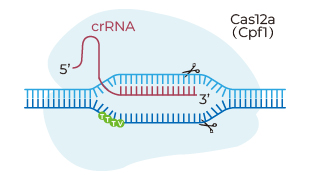
Here is a comprehensive guide for validating gRNA efficiency and editing
outcomes:
1. Initial Efficiency Assessment
T7 Endonuclease I (T7E1) Assay: A quick, cost-effective
screening method.
PCR amplify the target region, denature/reanneal, and digest with T7E1.
Cleaved products indicate indel formation.
Provides rough quantification (detection range: ~5–50%).
Surveyor Assay: Similar principle to T7E1 but more sensitive;
better for detecting low-frequency edits.
TIDE Analysis: Sanger sequencing–based quantification that
provides precise indel frequencies and patterns.
2. High-Resolution Analysis
Next-Generation Sequencing (NGS): Amplicon sequencing of the
target region provides detailed indel spectra and frequencies; can detect rare events (<1%).
Restriction Fragment Length Polymorphism (RFLP):
Applicable if editing disrupts or creates restriction sites; simple gel-based
readout but limited to specific sequence changes.
3. Protein-Level Validation
Western Blot Analysis: Confirms protein
knockout/knockdown; use multiple antibodies whenever possible.
Flow Cytometry: For surface proteins or fluorescent
markers; enables quantitative assessment of editing efficiency at single-cell
resolution.
Immunofluorescence: Assesses cellular localization and
expression changes, combining protein detection with morphological analysis.
4. Functional Validation
Phenotypic Assays: Include cell viability,
proliferation, and migration assays.
Metabolic Activity Measurements.
Drug Sensitivity Testing.
Reporter Systems:
GFP disruption assays for quick screening
Traffic light reporters for HDR efficiency
Split-fluorescent protein complementation assays
5. Precise Editing Validation (HDR/Base
Editing)
Allele-Specific PCR:
Design primers specific to the
edited sequence.
Confirms successful integration of desired changes.
Digital PCR (dPCR):
Highly quantitative measurement of editing ratios.
Superior sensitivity for low-frequency events.
Long-Range PCR:
Verifies large insertions and ensures surrounding regions remain intact.
Checks for unintended rearrangements.
6. Off-Target Assessment
Predicted Site Analysis: PCR amplify and sequence the
top predicted off-targets; use computational tools such as CasOFFinder or CHOPCHOP.
Unbiased Detection: Employ DISCOVER-Seq, CIRCLE-seq,
or GUIDE-seq for genome-wide off-target profiling.
7. Quality Control Measures
Multiple Time Points: Assess editing at 24 h, 48 h, 72
h, and 1 week to monitor editing kinetics and stability.
Clonal Analysis: Isolate single-cell clones for
homogeneous populations; allow detailed characterization of individual clones.
Essential for generating stable cell lines.
Multiple gRNAs: Test 2–3 gRNAs per target; consistent
results strengthen confidence in on-target specificity and help rule out off-target
effects.
8. Statistical Considerations
Experimental Design: Include appropriate controls
(mock, non-targeting gRNA). Use sufficient biological replicates (n ≥ 3) and
technical replicates for assay validation.
Data Analysis: Apply appropriate statistical tests,
correct for multiple comparisons when relevant, and report confidence intervals.
Recommended Validation Workflow
Phase 1: Initial Screening (24–48 h post-editing)
T7E1 or TIDE analysis for efficiency
Western blot for protein knockdown (if applicable)
Cell viability assessment
Phase 2: Detailed Characterization (72 h–1 week)
NGS amplicon sequencing for precise quantification
Functional assays relevant to the target gene
Check top 3–5 predicted off-target sites
Phase 3: Long-term Validation (1–4 weeks)
Clonal analysis of edited populations
Stability assessment over multiple passages
Comprehensive phenotypic characterization
Method Selection Guide
For screening multiple gRNAs: T7E1 or TIDE
For precise quantification: NGS amplicon sequencing
For protein validation: Western blot plus functional assays
For HDR validation: Allele-specific PCR plus Sanger sequencing
For off-target assessment: Targeted sequencing of predicted sites