




































Cytosine Base Editor
CBE4

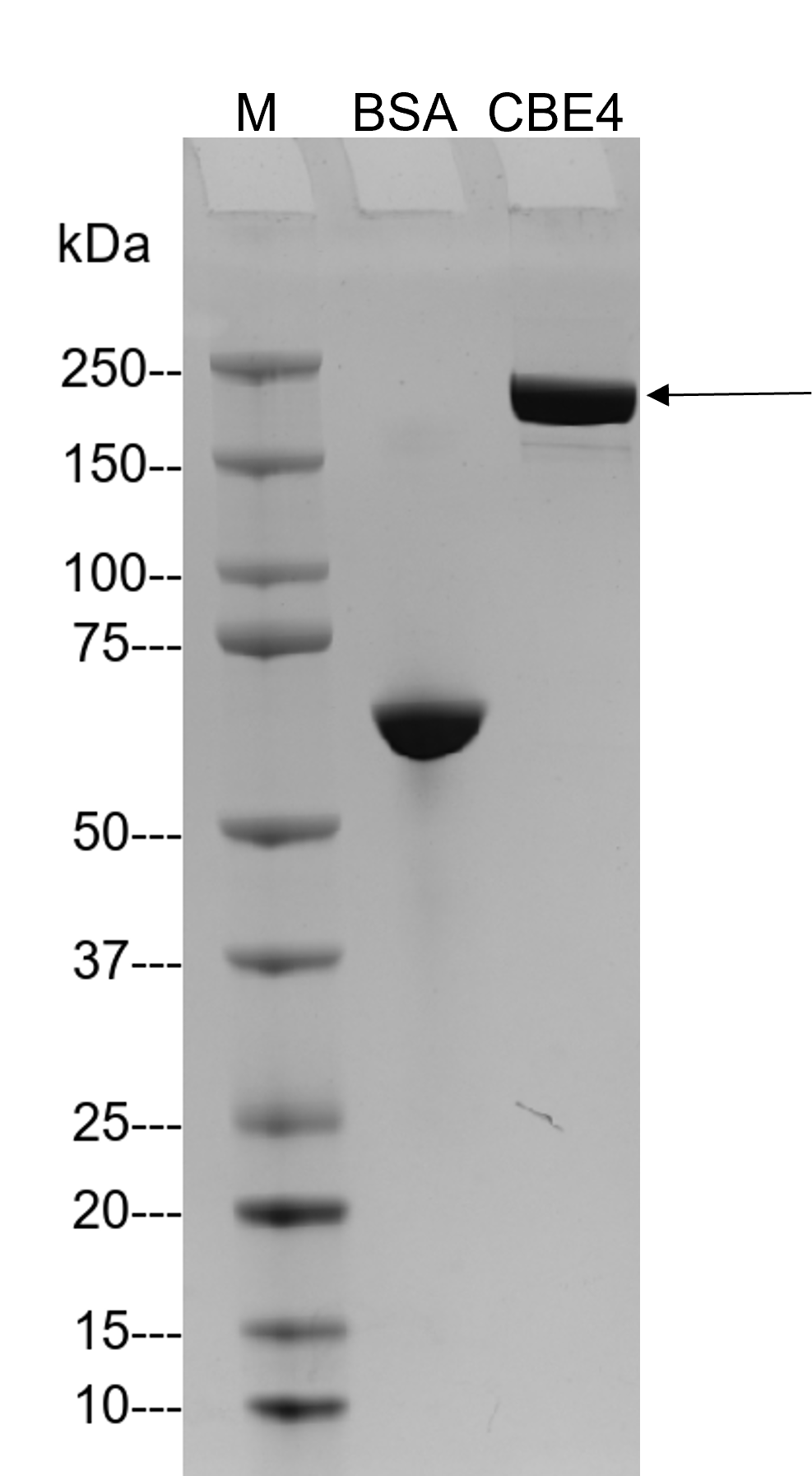
Fig.1 SDS-PAGE analysis of CBE4
Lane M: Protein Marker
Lane BSA: 2.00 ug BSA
Lane CBE4: CBE4 under reducing condition

CBE4

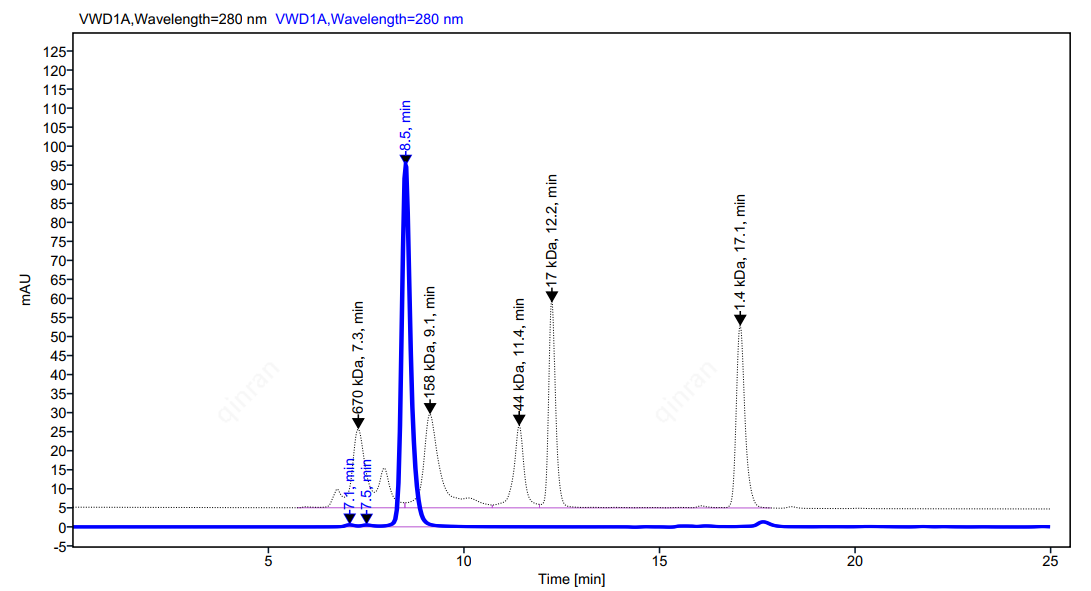
Fig.2 SEC-HPLC analysis of CBE4

CBE4

This product is temporarily unavailable, please contact your sales manager/technical account manager for more information.

If you have any question, please contact technical support [email protected].

CBE4 is a custom-engineered fusion protein consisting of APOBEC3A, nCas9 (Cas9 nickase), and a nuclear localization signal (NLS). Designed as a cytidine base editor, it enables programmable, site-specific C-to-T conversions in genomic DNA, without inducing double-strand breaks (DSBs). APOBEC3A is a single-stranded DNA-specific cytidine deaminase that catalyzes C-to-U (cytosine to uracil) deamination. In the cellular context, the resulting U•G mismatch is resolved by DNA replication or repair machinery, ultimately leading to a C•G to T•A substitution. nCas9 guides the editor to the target site via an sgRNA while minimizing off-target double-strand cleavage. The NLS ensures efficient nuclear import, enabling effective editing in mammalian cells. Together, these components form a high-efficiency, low-indel base editing tool suitable for diverse genome engineering applications.
RC00011
¥40,000.00

Ask us a question
Description

CBE4 is a custom-engineered fusion protein consisting of APOBEC3A, nCas9 (Cas9 nickase), and a nuclear localization signal (NLS). Designed as a cytidine base editor, it enables programmable, site-specific C-to-T conversions in genomic DNA, without inducing double-strand breaks (DSBs).
• APOBEC3A is a single-stranded DNA-specific cytidine deaminase that catalyzes C-to-U (cytosine to uracil) deamination.
• In the cellular context, the resulting U•G mismatch is resolved by the DNA replication or repair machinery, ultimately leading to a C•G to T•A substitution.
• nCas9 guides the editor to the target site via an sgRNA while minimizing off-target double-strand cleavage.
• The NLS ensures efficient nuclear import, enabling effective editing in mammalian cells.

Together, these components form a high-efficiency, low-indel base editing tool suitable for diverse genome engineering applications.

Applications
• Gene Correction: Precisely convert pathogenic C•G to T•A mutations in genetic disease models.
• Functional Genomics: Study gene function by introducing codon-level mutations without disrupting gene structure.
• Disease Modeling: Generate cell lines or organoids harboring specific single-nucleotide variants (SNVs).
• Preclinical Gene Therapy Research: Evaluate the safety and efficiency of base-editing as an alternative to DSB-mediated genome editing.
• Screening & Library Generation: Construct targeted mutation libraries for drug screening or protein evolution.

Properties
Expression System E.coli
Species S. pyogenes
PAM NGG
Tag C-His tag
Molecular Weight ~ 210 KDa
Storage & Stability CBE4 is supplied with storage buffer (50 mM Tris, 300 mM NaCl, 0.1 mM EDTA, 1 mM DTT, 50% Glycerol pH7.5, at 25°C) and recommended to be stored at -80°C.  

Quality Control Specifications
Purity ≥90% by SDS-PAGE, 99% by SEC-HPLC
Concentration ~ 10mg/mL
Residual DNase Non-specific DNase activity
Endotoxin Level <10 EU/mg
Exonuclease No detection

Examples
  • CBE4
  • CBE4

    Fig.1 SDS-PAGE analysis of CBE4
    Lane M: Protein Marker
    Lane BSA: 2.00 ug BSA
    Lane CBE4: CBE4 under reducing condition

  • CBE4
  • CBE4

    Fig.2 SEC-HPLC analysis of CBE4


Background
References 1. Heller M, Prigge ES, Kaczorowski A, von Knebel Doeberitz M, Hohenfellner M, Duensing S. APOBEC3A Expression in Penile Squamous Cell Carcinoma. Pathobiology. 2018;85(3):169-178. doi: 10.1159/000479007. Epub 2017 Nov 23. PMID: 29166639.
2. Koblan, L., Doman, J., Wilson, C. et al. Improving cytidine and adenine base editors by expression optimization and ancestral reconstruction. Nat Biotechnol 36, 843–846 (2018). https://doi.org/10.1038/nbt.4172
3. Yu, Y., Leete, T.C., Born, D.A. et al. Cytosine base editors with minimized unguided DNA and RNA off-target events and high on-target activity. Nat Commun 11, 2052 (2020). https://doi.org/10.1038/s41467-020-15887-5

For laboratory research use only. Direct human use, including taking orally, injection and clinical use, are forbidden.