










































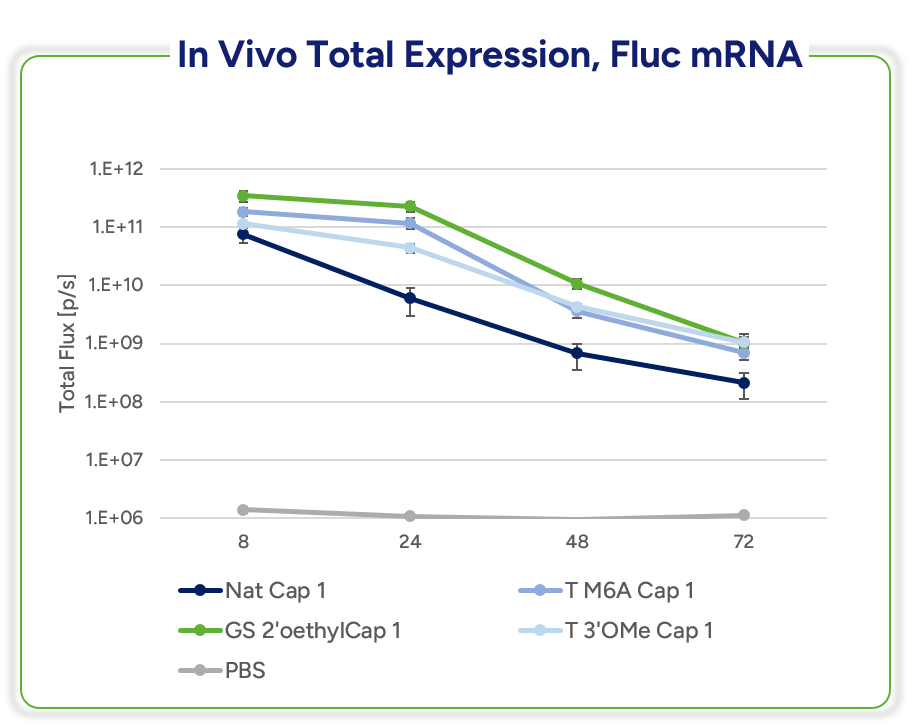
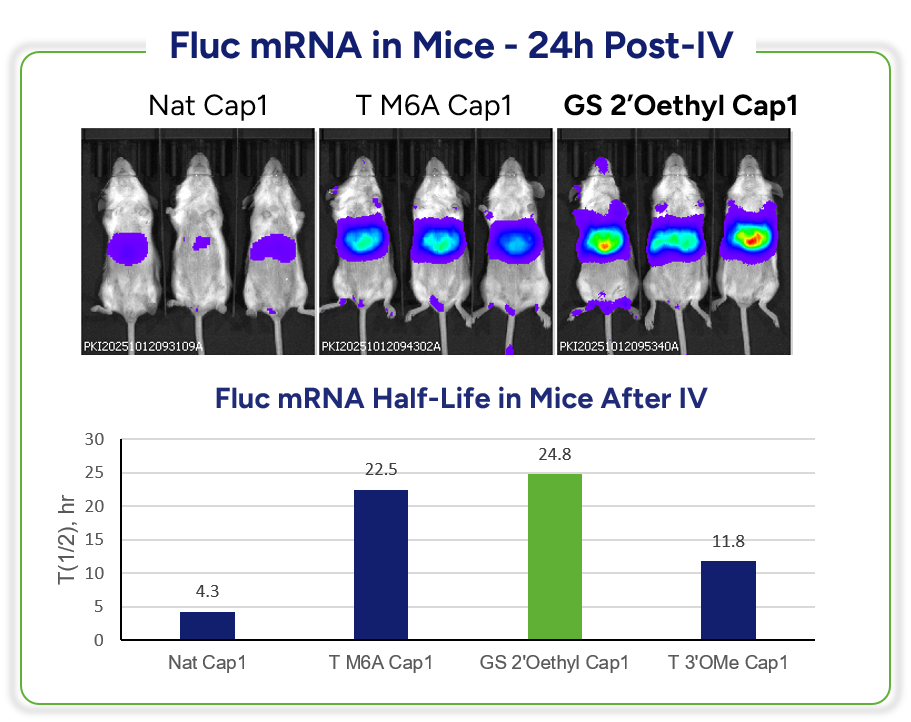
Novel 2’-O-Ethyl-capped RNA showed higher expression than natural Cap1 RNA, and slower clearance rate in vivo.

GenScriptの2'-O-エチル修飾Capを持つmRNAは、テストされた全てのCapアナログの中で最も高く、持続的な発現プロファイルを示します。そのため、持続的なタンパク質産生が求められるin vivoアプリケーションに最適な選択肢となります。
GenScriptのIVT mRNA製造ソリューションは、遺伝子合成からmRNA生産までのワークフローを簡略化します。当社のIVT mRNAは、独自の生産プラットフォームで最適化されており、品質と発現効率が保証されています。

コドン/UTR
最適化

遺伝子合成

クローニング/
プラスミド調製
即使用可能なRNA及びLNP -研究開発とイノベーションを強力に支援

トータルの製造プロセス
人工遺伝子合成からmRNA製造までのすべてのサービスをカバー

製造チームの高い経験値
mRNAのデザイン、製造の過程でお客様の時間や手間を削減

カスタマイズ可能なmRNA
既製品からカスタム品まで様々な選択肢をご提供
| 品質管理 | Item | Test Method | Specification | RUO Default |
RUO Upgrade |
Preclinical Default |
Preclinical Upgrade |
|---|---|---|---|---|---|---|---|
| Identification | Appearance | Visual Inspect | Clear and free of foreign particles | ||||
| RNA Length | Capillary Electrophoresis | Target ± 30% | |||||
| RNA Length | Agarose Gel Electrophoresis | Expected size band detected | |||||
| Poly A Length | Enzyme digestion and CE | Target ± 30% | |||||
| RNA Content | UV Absorbance | Target ± 5% | |||||
| PH | pH meter | Target ± 0.5 | |||||
| Buffer Specification | Client Spec | N/A | |||||
| Purity | A 260/280 Ratio | UV Spec | 1.70 ~ 2.30 | ||||
| Capping Efficiency | LC-MS | ≥ 90% | |||||
| Size based purity | Capillary Electrophoresis | ≥75% | |||||
| Impurity | Total protein residue | Nano Orange Assay | ≤ 1% | ||||
| Plasmid DNA Residue | qPCR | ≤ 0.05% | |||||
| dsRNA | Slot-blot | ≤ 0.1% | |||||
| Safety | Endotoxin | Semiquantitative | < 10EU/mg | ||||
| Endotoxin | Quantitative | < 10EU/mg | |||||
| Bioburden | Sdirect Inoculation | No Growth after 48 hrs |
注:追加の品質管理および評価をご希望の場合はお問合せください。
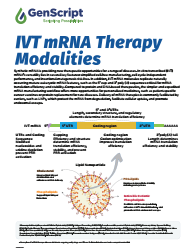
mRNA Infographic
IVT mRNAの主要な構造的特徴、機能および、
臨床応用が期待されているIVT mRNAを用いたワクチンの候補、治療におけるmRNAのキャリアーとしての脂質ナノパーティクルなどについて
ワクチン研究におけるmRNA合成サービスプラットフォーム
Novel 2’-O-Ethyl-capped RNA showed higher expression than natural Cap1 RNA, and slower clearance rate in vivo.
We can make mRNA from 100bp to 20kb in length. For oligo shorter than 100bp, our oligo synthesis team can take it under chemical syntehsis.
For RUO grade mRNA, we use silica membrane or LiCl precipitation method for purification. It is suitable for in vitro and invivo proof of concept studies.
For preclinical grade, we use HPLC based Oligo dT purification for improving RNA purity. Preclinical grade can be considered for long mRNA constructs >5kb or when high RNA purity (less fragment RNA ) is required for the project.
We can provide cGMP mRNA through our sister company ProBio. Please contact our technical support team.
Yes. We guarantee specific amounts of mRNA be delivered.
We ship mRNA at concentration of 0.5 ~2mg/mL by default. We can adjust concentration to a specific value <4mg /mL per customer's request at extra cost.
We offer 3 options of buffer: 1mM sodium citrate pH 6.5, TE pH7, and RNase-Free H2O. 1mM sodium citrate is our default option for better mRNA stability.
mRNA should be stable for at least 1 year if stored properly at -80°C upon receival and avoiding repeated freezing and thawing cycles, however mRNA stability varies depending on the length of mRNA. We have tested mRNA with stable results up to 3 freeze/thaw cycles. We recommend storing at -80°C for long time storage and -20°C for short term storage.
For RUO grade mRNA, we use silica membrane or LiCl precipitation method for purification.
For preclinical grade, we use HPLC-based Oligo dT purification for improving RNA purity.
In addition, we offer optional dephosphorylation to further reduce triphosphate RNA species in the final product to reduce its immunogenicity, and optional dsRNA removal HPLC purification to provide higher quality mRNA if low dsRNA residue is required.
Cellulose based HPLC method.
For size-based purity, we run the mRNA sample on bioanalyzer, then calculate the ratio of the main peak (target size +-15%) over the total AUC.
We recommend customers dephosphorylation as reducing the triphosphate-RNA species in mRNA by dephosphorylation could reduce its immunogenicity, thus making the transfected cells healthier and can express the target protein better.
Modifications help stabilize mRNA and reduce its immunogenicity.
We can substitute uridine bases with either 5-moU, N1-me-Ψ, Ψ, 5’-iodourdine, or Cy5-UTP.
We can substitute cytidine bases with 5-me-C, 5’-iodocytidine, or thiol-CTP.
We can substitute customizable percentage substitutions upon request. These will be not site specific modifications.
Capping can stablize RNA from 5'end and recruit ribosome. Cap1 and Cap 2 have a higher impact on mRNA stability compared to Cap 0 regarding protecting the mRNA from exonuclease degradation. It is common to use Cap1 for mammalian cells and Cap 0 for plant cells. Cap2 is a novel solution provided by GenScript that may work better than Cap1 in mammailan cells especiailly in immune-stressed conditions.
Cap1 via co-transcriptional capping is our default recommendation. We can also offer Cap0 and Cap1 enzymatically for an additional cost, and Cap2 RNA through co-transcriptional capping technology.
GenScript's proprietary capping technology can achieve >97% capping efficiency.
Yes, we offer mRNA QC service including capping efficiency assay using enzyme digestion /LC-MS method. Please contact our technical support team for details.
We use linearized DNA plasmid as a template for manufacturing your mRNA. The gene can be designed by our team using GenScript’s proprietary vectors and tools or we can use one of your designs. Once the design has been agreed to, we handle the gene and mRNA manufacture and provide you with mRNA as part of the fee-for-service agreement.
Yes, it is possible, please contact our technical support team.
For making cap1 mRNA using co-transcriptional capping technology, either AGG or GGG following T7 promoter seq is required. For self-amplifying RNA usually ATG after T7 promoter.
Yes, we can do codon optimization. Please contact our technical support team.
Yes. we can subclone your ORF sequences into our proprietary vector which contains T7 promoter, UTR and 100A for mRNA production.
We use RNaseT1.
Yes, please refer to https://www.genscript.com/mrna-qc-services.html.
Approximately 0.5ug to 1 ug of mRNA is usually used for transfecting each well in 24 well plate.